Can a doctor lose his license for dating a patient? Yes, engaging in a romantic relationship with a patient can create serious professional consequences for physicians in Texas. Under Texas law and professional guidelines, initiating or continuing a romantic or sexual relationship with a current patient can be seen as a violation of ethical duties and could result in disciplinary action.
At Lype Dest Smith Lawyers, our Texas Medical Board Lawyer team helps medical professionals respond to boundary complaints with discretion and urgency. We work to preserve your license, protect your reputation, and safeguard your medical future.

When a physician crosses personal boundaries with a patient, it disrupts the foundation of the physician-patient relationship. The physician-patient relationship is built on trust, confidentiality, and objectivity. Entering into a romantic or sexual relationship, even if ostensibly consensual, can compromise a doctor’s clinical judgment and undermine informed consent. The American Medical Association has stated that sexual or romantic contact with a current patient is unethical because of the inherent imbalance of power and the potential for exploitation, as noted in the Code of Medical Ethics.
Patients seeking medical treatment are in an inherently vulnerable situation, and any hint that their care may be influenced by personal interest, whether real or perceived, can lead to feelings of betrayal or coercion. Even after the romantic involvement ends, the breach of professional boundaries may leave lasting harm and leaves the physician’s license at risk.
Get a Consultation Today!
The Texas Medical Board (TMB) holds physicians to high ethical and professional standards. Violating those standards, including engaging in inappropriate patient relationships, can have severe consequences. These issues are often evaluated as examples of unprofessional behavior in healthcare and how they can affect your license. The Board views these actions as unprofessional conduct under Texas Occupations Code Chapter 164 and will likely open a formal investigation if a complaint is received.
Under this statute, the Board may issue sanctions ranging from public reprimands to complete license revocation, depending on the nature and severity of the boundary violation. Complaints of this nature can result in:
Potential Criminal Sanctions Engaging in Sexual Conduct with a Patient or Former Patient.
A non-consensual sexual encounter initiated by a physician with a patient obviously could support a criminal investigation and criminal sanctions. However, even if the encounter is ostensibly consensual, the Texas Penal Code Chapter 22.011(9) makes it an offense for a mental health provider or health care services provider to engage in sexual activity with a patient or former patient if it can be shown that they did so by exploiting the patient’s emotional dependency on the mental health provider or other healthcare provider.
The infographic below explains how the Texas Medical Board evaluates boundary violations involving physician-patient relationships and the potential consequences for your license.
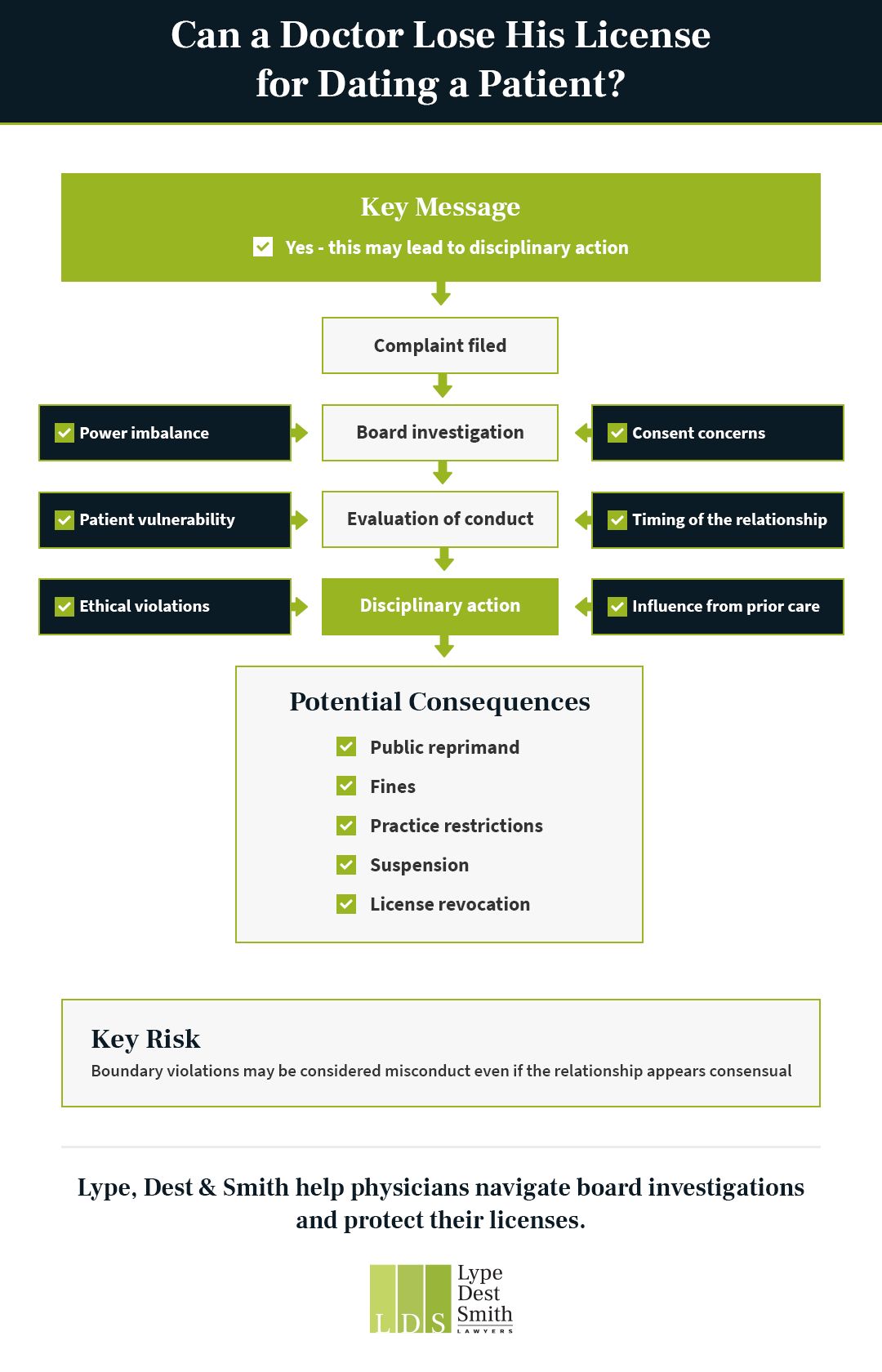
How boundary violations may lead to disciplinary action by the Texas Medical Board
Dating a current patient is almost always a direct violation of medical ethics and can trigger immediate disciplinary action. On the other hand, relationships with former patients may seem more ambiguous, but they can still lead to complaints and sanctions depending on the circumstances.
For instance, if a physician begins a relationship with a former patient shortly after ending the professional relationship, the TMB may question whether consent was truly free of coercion. The closer the timing, the more likely the Board may view the relationship as inappropriate. There is no “safe” time frame; it’s a case-by-case assessment considering context and perceived exploitation.
The argument most often used in disciplinary hearings is the existence of a power imbalance. Even in cases involving former patients, the Board may view the relationship as problematic due to a doctor’s residual influence over the patient. This power dynamic can be perceived as impairing the patient’s ability to offer genuine consent. Other factors, such as stress and exhaustion, also raise concerns, and many physicians wonder: can burnout lead to losing your medical license?
Physicians are often held to a higher standard, and any suggestion that they used their authority or trust built during treatment to initiate intimacy may result in formal action.
Boundary violations aren’t just ethical slip-ups. They carry real professional risks. A Texas physician may be subject to:
According to the Texas Occupations Code §164, the Board may revoke or suspend a license, place the license holder on probation, or impose other sanctions if it finds evidence of unprofessional conduct.
In one high-profile disciplinary case, a physician was found to have engaged in romantic relationships with multiple patients. Despite arguing that the relationships were consensual, the physician lost his license due to concerns about objectivity, manipulation, and the betrayal of trust.
Yes, a doctor can lose their license for dating a patient. Initiating or maintaining a romantic relationship with a patient violates ethical codes and can result in complaints, investigations, and sanctions that jeopardize a medical career.
Complaints involving boundary violations with patients can seriously risk your license. Responding quickly and carefully is critical, especially if the Texas Medical Board begins a formal investigation.
At Lype Dest Smith Lawyers, we guide physicians through every step of the disciplinary process with clarity and resolve. With decades of combined legal experience, our team helps doctors protect their licenses, careers, and professional futures. Call 512-881-3556 to protect your license and your future.

Not afraid to go to court when necessary, Dan has successfully litigated cases all the way to the Supreme Court of Texas. Dan also prides himself on being readily available to clients throughout their cases. He strongly believes effective representation should be a collaborative effort between a client and their attorney.
Years of experience: 15 years
Justia Profile: Dan Lype
Bar number: 24065658
Location: Austin, TX

Key Takeaways Discipline by another state's medical board opens a separate Texas review but does not automatically discipline the...
read more
Key Takeaways A Texas Medical Board complaint can escalate into a formal investigation or disciplinary proceedings quickly. Wr...
read more
Key Takeaways A signed agreed order becomes part of the public disciplinary record and may affect hospital privileges. Agreed ...
read moreIf you or a loved one needs legal help, please fill out the form below for your consultation or call us at 512-881-3556